Why this matters (and why your future self will thank you)
If you’ve ever told a preschooler “no” and watched them melt into a dramatic puddle—then popped back up like a pasta noodle—welcome. You are raising or teaching a tiny human who is practicing self-control, empathy, and safety. Boundaries aren’t buzzkills; they’re seat belts for the heart and brain.
This guide gives you a full toolkit—clear language, playful songs, easy visuals, and classroom/home activities—to teach what “no,” “can’t,” and “don’t” mean, how to say them kindly, and how to respect them quickly. It’s warm, practical, a little funny, and grounded in research.
TL;DR (for snack time)
- “No/Can’t/Don’t” = stop or wait. Respecting these words protects bodies, feelings, and friendships.
- Body autonomy is protective: teaching kids to ask before touch and to say no to unwanted touch supports safety and consent. AAP Publications+1
- Boundaries build brains: responsive caregiving and practice with self-regulation (aka “executive function”) help children manage impulses and make good choices. developingchild.harvard.edu+1
- When grown-ups say “no,” it’s usually about safety and health—that’s the heart of authoritative parenting: warmth + clear limits. NCBIPMC
- Prevention education helps: age-appropriate consent/safety lessons increase protective knowledge and skills in kids. Cochrane LibraryPubMed
The big idea: Boundaries are love you can see
“Stop, please.” “No, thank you.” “I don’t want a hug right now.” For preschoolers, these phrases are superpowers. They help kids protect their own bodies and honor other people’s choices—cornerstones of consent. Pediatric experts encourage families to teach body boundaries early, including that no one should look at or touch private parts without permission, and it’s okay not to give hugs or kisses if you don’t want to. Contemporary Pediatrics
The American Academy of Pediatrics highlights body autonomy as a promising way to reduce risk, and encourages clear, developmentally-appropriate safety rules and scripts for families. AAP Publications
The science (friendly edition)
1) Self-regulation = the “air traffic control” of the brain
Kids aren’t born with self-control; they build it through practice and responsive adult support. Harvard’s Center on the Developing Child explains that executive function skills (focus, impulse control, working memory) start early and are strengthened by back-and-forth interactions (“serve and return”)—like the moment you pause, read a child’s cue, and adjust. That tuning-in is what helps kids stop when they hear “no,” and wait when they hear “can’t.” developingchild.harvard.edu+1
2) Consent & safety education works (with age-appropriate framing)
Comprehensive reviews show school-based child sexual abuse prevention programs increase children’s protective knowledge and skills (e.g., recognizing unsafe situations, saying “no,” getting help). For preschoolers, this looks like simple rules, picture cues, and practiced scripts—never fear-based messaging. Cochrane LibraryScienceDirect
3) Warmth + clear boundaries = best overall outcomes
An authoritative parenting approach—high warmth with consistent, explained limits—is repeatedly associated with positive social, emotional, and academic outcomes in children. That balance is exactly what “respecting no” feels like: kind voice, firm boundary. NCBIPMC
What “No,” “Can’t,” and “Don’t” mean to a preschooler (plain language)
- “No”: Stop now.
- “Don’t”: Stop and choose something else.
- “Can’t”: It isn’t allowed or safe right now; we may try later or another way.
Use visuals (hand as a stop sign, red card for “stop,” green for “go”). Pair words with gestures to anchor meaning for pre-readers.
How to teach consent the preschool way (scripts you can say today)
1) Model + narrate consent in daily life
- “Can I give you a hug, or high-five?” (Pause for answer.)
- “You said no—thank you for telling me. I’ll wave instead.”
- “Max said ‘don’t take my car.’ Let’s give it back and pick another toy.”
This everyday modeling matches pediatric guidance to ask before touch and respect refusals, even with family members. It normalizes consent as kindness—not a punishment. AAP Publications
2) Use short, repeatable scripts with actions
- Child saying no: “No, thank you. I don’t want a hug.” (Step back, palm out.)
- Friend hearing no: “Okay! I’ll ask later.” (Hands to self, smile.)
- Grown-up boundary: “Don’t run into the street. I’m keeping you safe.” (Hold hands.)
3) Practice “stop/wait/choose” games
Turn boundaries into a movement game:
- Call “No!” → everyone freezes.
- Call “Can’t!” → everyone waits, counts to five, then makes a new choice.
- Call “Don’t!” → everyone stops and picks a different action (e.g., jump instead of run).
4) Try role-play with puppets
Let Sunny the Bunny and Max the Dog practice asking, refusing, and respecting. Kids learn faster when they can see it, say it, and play it.
When grown-ups say “no”: the love behind the limit
Preschoolers often hear “no” about safety (streets, stoves), health (candy before bed), and timing (“not yet”). The goal isn’t control—it’s care. In authoritative parenting, limits are explained and consistent, and kids still feel heard and connected. That combo is linked to healthier behavior and learning outcomes. NCBIPMC
Try this script:
“I hear you want a cookie. Right now my job is to keep your body healthy. So: no cookie before dinner. After dinner, we can check again.”
Kids don’t need a TED Talk. They need one sentence, a reason, and a when (“not yet/after dinner/tomorrow”). That structure builds trust.
Classroom & home visuals (fast to make, easy to use)
- Stop/Go Cards (red/green)
- Choice Board: “No/Don’t/Can’t → What can I do instead?” (picture icons for blocks, books, drawing, cozy corner)
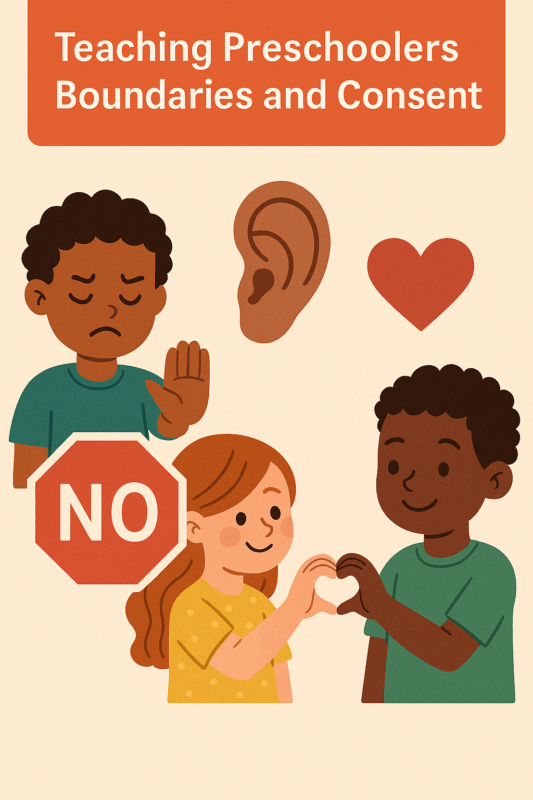
- “Ask First” Poster: “Ask → Listen → Respect” with a hand, ear, and heart icon
- Doorway Routine: “Do we have our safe bodies?” (hands to self, slow feet, listening ears)
Songs preschoolers will actually sing (and remember)
(Use familiar tunes so they “stick.” Add hand motions: palm-out stop; hands to heart for kindness.)
1) When I Say No (to “If You’re Happy and You Know It”)
When I say no, please stop right away (clap, clap)
When I say no, please stop right away (clap, clap)
It means I need my space,
Please respect my face—
When I say no, please stop right away!
Repeat with don’t and can’t (“Can’t means wait, it’s true—We’ll find something new!”).
2) Stop Means Stop (call-and-response)
Leader: Stop means stop, yes it does!
Kids: Stop means stop, yes it does!
Leader: When we hear no/can’t/don’t,
Kids: We stop because we care!
3) When Grown-Ups Say No (to “London Bridge”)
When grown-ups say no to me,
(It means love, it means love)
When grown-ups say no to me,
They keep me safe!
Sometimes it means not right now,
(Not right now, not right now)
Sometimes it means not right now,
And that’s okay!
Common sticky spots (with gentle, funny solutions)
“Grandma wants a hug and my kid says no… help.”
Try: “Grandma, can we choose a high five, blow a kiss, or a wave?” Your child’s boundary stays intact, Grandma still gets a moment of connection, and nobody feels like the villain in a holiday special. Pediatric guidance supports not forcing affection and modeling consent in everyday life. AAP Publications+1
“My student says no to everything.”
Shift to offer-and-choice: “You can hold my hand or hold the rope—what’s your pick?” Many “no’s” soften when kids feel a little control inside a safe boundary. That’s executive function practice in disguise. developingchild.harvard.edu
“They keep taking toys even after ‘don’t.’”
Use a visual timer (30–60 seconds) and a Turn Card (picture of two hands trading). Narrate: “Clara said don’t take my block. We’re waiting. When the timer dings—turn.” Rehearsal builds the skill.
“They say ‘no’ to a safety rule.”
Acknowledge the feeling + restate the boundary:
“I hear you want to run. Don’t run in the parking lot. Hold my hand. We’ll race on the grass.” You’re firm and kind—authoritative in action. NCBI
Evidence corner: What the research says (and how to use it)
- Teaching body autonomy and consent early is protective. The AAP encourages caregivers to talk about private parts, permission, and safe/unsafe touches in simple terms—all part of body autonomy and safety. AAP PublicationsContemporary Pediatrics
- Age-appropriate prevention education improves kids’ protective knowledge and skills. Systematic reviews (including Cochrane) find gains in recognizing unsafe situations, saying “no,” and getting help. For preschoolers, keep it calm, concrete, and practice-based—no scary details. Cochrane LibraryScienceDirect
- Self-regulation grows through responsive interaction and practice. The Center on the Developing Child describes how serve-and-return and daily routines strengthen the brain systems that help kids stop, wait, and choose—the foundation of boundary skills. developingchild.harvard.edu
- Warmth + structure outperforms either alone. Authoritative parenting (high warmth, clear limits) is consistently linked to positive outcomes and healthier behavior—exactly the vibe you want when you say “no” with love and a plan. PMC
Ready-to-use mini-lessons (circle time or kitchen table)
Lesson 1: The Stop Sign
- Show a red stop sign card. Ask: “What do we do when we see this?”
- Practice: Adult says a silly action (“Wiggle like spaghetti!”), then “No!” → freeze.
- Language: “When someone says no/don’t/can’t, our bodies stop.”
Lesson 2: Ask–Listen–Respect
- Poster with three icons: Ask (hand), Listen (ear), Respect (heart).
- Role-play: Child asks, “Can I hug you?” Partner says “No, thanks.” Child says, “Okay!” and waves.
Lesson 3: Safe vs. Unsafe
- Show picture cards (street, stove, bedtime).
- Sort into Try Now, Try with a Grown-Up, Try Later.
- Script: “Grown-ups’ ‘no’ helps keep our bodies safe and healthy.” Contemporary Pediatrics
Lesson 4: Turn-Taking with a Timer
- One toy, two players.
- Person A says, “Don’t take my toy.” Set a 45-second timer; on ding, switch.
- Celebrate both roles: “You respected a boundary!”; “You waited your turn!”
Printable lyrics & anchor chart text (copy/paste into your sheets)
Anchor Chart: “No/Don’t/Can’t”
- No = stop now
- Don’t = stop and choose something else
- Can’t = not safe/allowed right now (maybe later)
“When I Say No” (lyrics) – see song section above
“Stop Means Stop” (lyrics) – call-and-response above
“When Grown-Ups Say No” (lyrics) – London Bridge version above
Add simple 16:9 visuals for your classroom screen or handouts: a red palm (stop), ear (listen), heart (respect).
Quick FAQ for caregivers & teachers
Q: Won’t teaching kids to say “no” make them defiant?
A: Teaching kids when and how to say “no” (and how to hear it) reduces power struggles long-term. It channels that independence into safe, prosocial skills anchored by your steady limits. That’s the authoritative sweet spot. PMC
Q: How early can we start?
A: Right away—in toddlerhood, with simple consent language (“Your body is yours,” “Ask before you touch”). These early, responsive interactions are where self-regulation starts. developingchild.harvard.edu
Q: What about family members who expect hugs?
A: Offer choices (“high five, wave, or blown kiss?”). Pediatric sources explicitly note children don’t have to hug or kiss anyone if they don’t want to. AAP Publications
Q: Do school prevention programs really help?
A: Evidence shows they increase protective knowledge and skills. For preschoolers, keep it developmentally gentle and always follow with trusted-adult messaging (“Tell a grown-up you trust”). Cochrane Library
The Miss Annette way: kindness first, boundaries always
Here’s your cozy close: Boundaries aren’t walls; they’re welcome mats with instructions. “Here’s how to be close to me and still help me feel safe.” When we teach preschoolers to say no kindly and hear no quickly, we’re raising kids who are confident, empathetic, and safe—and classrooms that hum like happy beehives.
Chant it out one more time:
No means stop. Don’t means stop. Can’t means wait or safe.
Ask, listen, respect—everybody feels safe.
Let’s learn and play, the Miss Annette’s way. 💛
Sources & further reading
- American Academy of Pediatrics (AAP), Child Sexual Abuse Prevention: What Parents Need to Know (2024). Focuses on body autonomy, permission, and simple scripts for families. AAP Publications
- AAP coverage on body boundaries and safety tips for parents. Contemporary Pediatrics
- Harvard Center on the Developing Child, Guide to Executive Function and Serve & Return key concepts—how responsive interaction builds self-regulation. developingchild.harvard.edu+1
- Cochrane Review and newer systematic reviews on child sexual abuse prevention education effectiveness (skills/knowledge gains). Cochrane LibraryScienceDirect
- Authoritative parenting overview and outcomes (StatPearls review; narrative review in Frontiers in Psychology). NCBIPMC
- Child Mind Institute, Teaching Kids About Boundaries (practical consent language, everyday modeling). Child Mind Institute

This is an excellent set of lessons and exactly what I was looking for! Thank you so much for sharing!